European Jobs Monitor
The European Jobs Monitor helps you to track structural change in European labour markets.
The European Jobs Monitor (EJM) tracks structural change in European labour markets. It analyses shifts in the employment structure in the EU in terms of occupation and sector and gives a qualitative assessment of these shifts using various proxies of job quality – wages, skill levels, etc. Is employment growing relatively fastest in low-paid, mid-paid or high-paid jobs? The EJM covers all 27 EU Member States and is based primarily on analysis of the European Union Labour Force Survey (EU-LFS) data. In July 2026, the EJM interactive dataset was updated to include the most recent annual EU-LFS data up to 2024 for all Member States, as well as for the EU27 as a whole.
There were nearly 17 million more persons in employment in the EU27 in 2024 compared to 2011 and around three quarter of this increase was in well-paid jobs in the top quintile by pay (+12.8m).
2011–2024 has been a period of employment upgrading in the EU as a whole and the majority of Member States experienced stronger employment growth in well-paid compared to low-paid or mid-paid jobs.
The EU27 female workforce has expanded faster than the male workforce notably in mid- and high-paid jobs.
The COVID-19 crisis appears to have reinforced employment upgrading – by accelerating the growth in well-paid employment in the digital economy but also the contraction of lower-paid, in-person services employment.
While nearly all of the net new employment over the last decade has come in services, manufacturing has also contributed positively to employment growth especially in high-paid jobs (science/engineering as well as business/administration professionals).
The share of employment in the EU27 that is ‘core’ or standard has been increasing. While there has been some growth in part-time employment, this have been offset by greater declines in self-employment and in temporary employment. Nonetheless, non-standard employment has increased in well-paid jobs accounting for around 30% of net new top-quintile jobs (3.5 million of 12.8 million). Non-standard employment therefore has also been upgrading.
The European Jobs Monitor (EJM) uses a jobs-based approach to analysing structural shifts in employment in Europe. The key methodological innovation of such a jobs-based approach is to observe employment developments at the level of the job (understood as a given occupation in a given sector) rather than at the level of the individual worker, as is the more customary approach in analysis of labour market developments.
Using the standard international classifications of occupation (ISCO-08) at two-digit level and sector (NACE Rev 2.0) at one-digit level, a matrix of jobs is created in each country. Each job is an occupation in a sector. In total, there are 43 two-digit occupations and 23 one-digit sectors, which generates 989 job cells. In practice, many of the theoretical job cells do not contain employment; there are unlikely to be many skilled agricultural workers in financial services, for example. The country total of job cells with employment varies between around 400 and just over 800 and is largely determined by country size and the European Union Labour Force Survey (EU-LFS) sample size. The bigger the workforce, the greater is the variety of possible job combinations that can be identified using LFS data.
The jobs in each country are ranked, based on some ranking criterion, for example the mean hourly wage. The job–wage rankings for each country used in the most recent analysis are based mainly on microdata from the Structure of Earnings [SES] survey (for three waves, 2014, 2018 and 2022) supplemented by data from the EU-LFS annual data files for 2014–2020 to cover sectors not covered in the SES. These sources allowed the creation of country job–wage rankings for the 27 EU Member States. There are also two other job quality criteria used in alternative rankings – job education (based on the weighted average education level of job holders, source: LFS) and broader job quality (based on the weighted average score across seven job quality dimensions, source: European Working Conditions surveys 2015 and 2024).
Jobs were allocated to quintiles in each country based on the job–wage ranking for that country. The best-paid jobs are assigned to quintile 5, the lowest-paid to quintile 1. Each quintile in each country should represent as close as possible to 20% of employment in the starting period, i.e. jobs are assigned to quintiles based on their employment weights. Hereafter, the job-to-quintile assignments remain fixed for each country so that in all of the charts that follow a given quintile in a given country (however decomposed) always refers to employment data in a specific group of jobs exclusive to that quintile. For presentation purposes, the focus then is shifted to the change in the stock of employment at quintile level during a given period in each country, e.g. 2019–2024. The chart below illustrates in simplified format the three steps outlined above, using some of the top-paid and lowest-paid jobs that employ large numbers at EU level as examples. (While the jobs are correctly assigned in terms of EU quintile, the individual job–wage ranks, 1–4 and 1105–1108, are for illustrative purposes only.)
Job rankings and quintile assignments carried out for each country
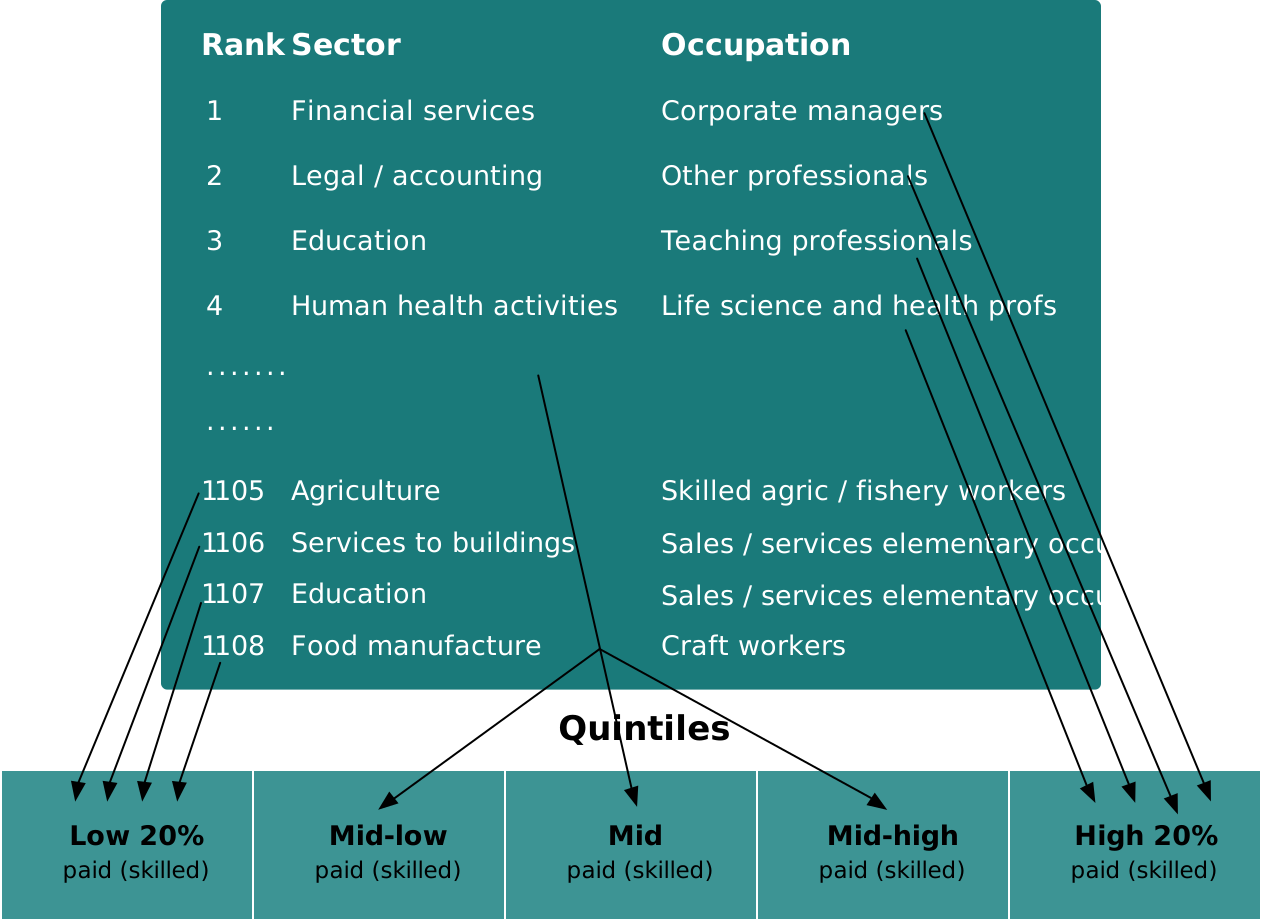
Net employment change between starting and concluding periods (in persons employed) for each quintile in each country is summed to establish whether net job growth has been concentrated in the top, middle or bottom of the employment structure. Except where otherwise indicated, all charts in the report describe net employment change by quintile for the indicated country or for the EU as a whole. The EU aggregate charts are based on applying a common EU job–wage ranking (based on the weighted average of the standardised national job–wage rankings).
The resulting quintile charts give a simple, graphical representation of the extent of employment change in a given period, as well as an indication of how that change has been distributed across jobs at different pay levels. A similar classification of jobs can be done using jobholders’ skills or a broad-based, multidimensional indicator of job quality as a ranking criterion and data is also provided for the resulting breakdowns.
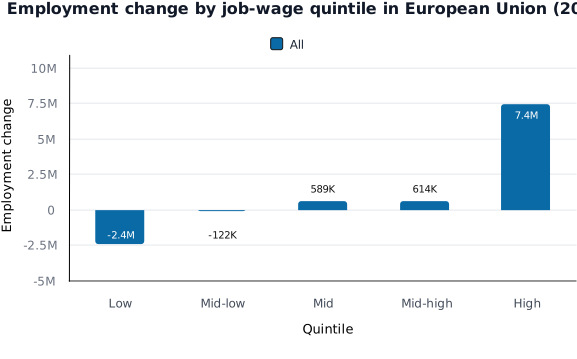
The quintile chart below, for example, illustrates employment change for the EU27 during 2019–2024. The figure should be read from the leftmost bar cluster (quintile 1, representing the lowest-paid jobs) to the rightmost cluster (quintile 5, representing highest-paid jobs). Net employment change is represented on the vertical axis, in thousands (k) or millions (m). The dominant features of the chart are the loss of 2.4 million low-paid jobs (bottom quintile) as well as the simultaneous addition of around 7.4 million well-paid jobs (top quintile) over the pandemic and post-pandemic period.
This method also offers further possibilities of breaking down these net employment changes by such categories as gender, employment or professional status, and working time category: full time or part time. For a more extensive description of the data-processing involved, please refer to the extensive material in the annexes of previous EJM annual reports where the same jobs-based approach was used.
Finally, bar charts are also provided indicating the employment levels by job quintile. By construction, these charts show even quintiles in the start year (2011); the employment totals thereafter reflect the change in employment across all of the individual jobs assigned to each quintile over the period up to 2019 or 2024 (noting that the job-to-quintile assignments are fixed across the entire period).
Find all Eurofound publications on the EJM below.